Introduction
China has been the world’s most populous country for decades. For many years, its population grew rapidly and became one of the key reasons behind China’s rise as a global manufacturing and economic powerhouse. However, this trend has changed dramatically in recent years.
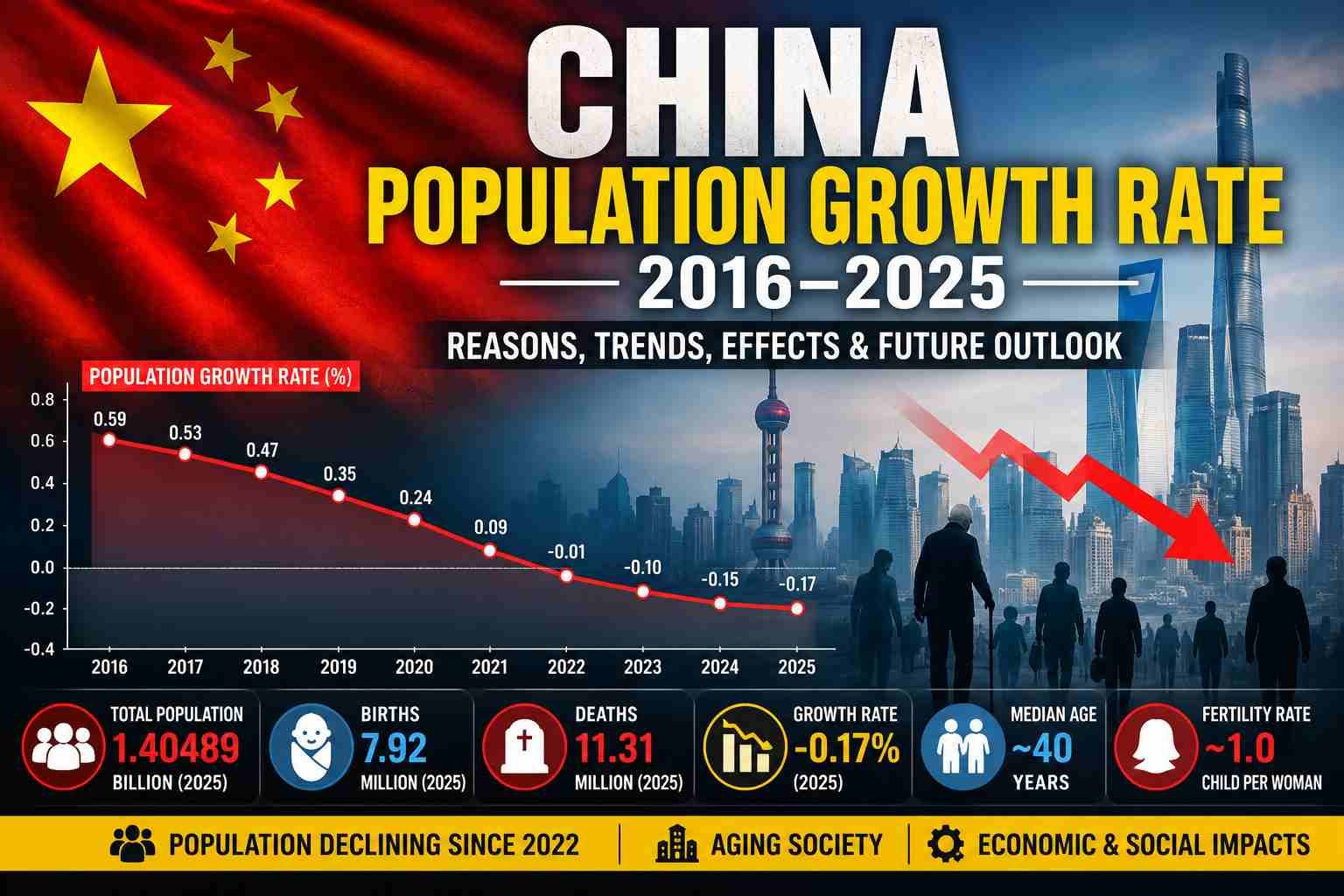
Since 2022, China has entered a period of population decline, with more people dying each year than are being born. The country’s birth rate has fallen to historic lows, while the number of elderly people continues to rise. This demographic shift is creating major challenges for China’s economy, labour market, healthcare system, pension funds, and long-term global influence.
According to the National Bureau of Statistics of China, China’s total population continued to decline in 2023, 2024, and 2025, making it one of the most significant demographic changes of the 21st century.
In this article, we examine:
- China’s population growth over the last 10 years
- Official population growth rate trends
- Why the population is shrinking
- Key demographic statistics
- What this means for China’s future and the global economy
China Population Overview (2025)
| Indicator | Latest Data (2025) |
|---|---|
| Country | China |
| Total Population | 1.40489 Billion |
| Population Rank | 2nd Largest (after India) |
| Population Growth Rate | -0.17% |
| Births | 7.92 Million |
| Deaths | 11.31 Million |
| Natural Population Change | -3.39 Million |
| Median Age | ~40 Years |
| Fertility Rate | Around 1.0 child per woman |
| Urban Population | Approximately 67% |
China now has one of the lowest fertility rates in the world, well below the replacement level of 2.1 children per woman.
China’s Population Growth Rate: Last 10 Years (Official Trend)
| Year | Population Growth Rate (%) |
|---|---|
| 2016 | 0.59 |
| 2017 | 0.53 |
| 2018 | 0.47 |
| 2019 | 0.35 |
| 2020 | 0.24 |
| 2021 | 0.09 |
| 2022 | -0.01 |
| 2023 | -0.10 |
| 2024 | -0.15 |
| 2025 | -0.17 |
Key Observation
- Between 2016 and 2021, population growth slowed every year.
- 2022 marked China’s first annual population decline in more than six decades.
- Population decline continued in 2023, 2024, and 2025, indicating that the trend is structural rather than temporary.
China’s Total Population (2016–2025)
| Year | Population (Billion) |
|---|---|
| 2016 | 1.379 |
| 2017 | 1.386 |
| 2018 | 1.393 |
| 2019 | 1.398 |
| 2020 | 1.412 |
| 2021 | 1.413 |
| 2022 | 1.412 |
| 2023 | 1.410 |
| 2024 | 1.407 |
| 2025 | 1.405 |
What Is Population Growth Rate?
Population Growth Rate refers to the percentage increase or decrease in a country’s population during one year.
A positive growth rate means:
- More births than deaths
- Population increases
A negative growth rate means:
- More deaths than births
- Population decreases
China is currently experiencing negative population growth, meaning the country’s population is shrinking every year.
Why Is China’s Population Declining?
China’s population decline is not caused by a single reason. Instead, it is the result of multiple demographic, economic, and social factors that have developed over several decades.
The biggest reasons include:
- Very low birth rate
- Aging population
- Fewer marriages
- High cost of raising children
- Expensive housing
- Career-focused young adults
- Urban lifestyle changes
- Legacy of the One-Child Policy
Each of these factors reinforces the others, making population recovery difficult.
Reason 1: The Legacy of the One-Child Policy
China introduced the One-Child Policy in 1979 to slow rapid population growth.
For more than three decades:
- Most urban couples could have only one child.
- Families became much smaller.
- Fertility rates fell sharply.
- Millions of potential births never occurred.
Although the policy ended in 2015, its long-term effects remain.
Many young adults today grew up as only children and are choosing to have only one child—or none at all.
This demographic momentum cannot be reversed quickly because there are now fewer women of childbearing age than in previous generations.
Reason 2: China’s Birth Rate Has Fallen to Historic Lows
One of the main reasons for population decline is the continuous fall in births.
China now records its lowest birth rate since modern records began.
Young couples increasingly delay marriage, postpone parenthood, or decide not to have children at all.
As births continue to decline while deaths rise due to population ageing, natural population growth becomes negative.
Reason 3: High Cost of Raising Children
Having children in China has become increasingly expensive.
Major costs include:
- Housing
- Childcare
- Education
- Private tutoring
- Healthcare
- Daily living expenses
In many large cities such as Beijing, Shanghai, and Shenzhen, raising one child can cost hundreds of thousands of dollars over the course of childhood.
Because of these financial pressures, many couples decide to have only one child or remain child-free.
Reason 4: Expensive Housing
Housing prices have increased dramatically over the past two decades.
Buying a home is considered essential before marriage in many parts of China.
However:
- Home prices are extremely high.
- Mortgage payments are large.
- Young adults delay marriage.
- Delayed marriage leads to delayed childbirth.
Housing affordability has therefore become an indirect factor behind China’s falling birth rate.
China’s Birth Rate: Last 10 Years
The birth rate measures the number of live births per 1,000 people in a year. China has witnessed one of the steepest declines in birth rates among major economies.
| Year | Birth Rate (per 1,000 people) | Estimated Births (Million) |
|---|---|---|
| 2016 | 12.95 | 17.86 |
| 2017 | 12.43 | 17.23 |
| 2018 | 10.94 | 15.23 |
| 2019 | 10.48 | 14.65 |
| 2020 | 8.52 | 12.00 |
| 2021 | 7.52 | 10.62 |
| 2022 | 6.77 | 9.56 |
| 2023 | 6.39 | 9.02 |
| 2024 | 6.10 | 8.54 |
| 2025 | 5.63 | 7.92 |
Key Highlights
- Births have fallen by more than 55% since 2016.
- Annual births dropped from nearly 18 million to below 8 million.
- This is one of the fastest fertility declines among large countries.
China’s Death Rate: Last 10 Years
While births have declined, deaths have gradually increased because China’s population is ageing.
| Year | Death Rate (per 1,000 people) | Estimated Deaths (Million) |
|---|---|---|
| 2016 | 7.09 | 9.79 |
| 2017 | 7.11 | 9.86 |
| 2018 | 7.13 | 9.95 |
| 2019 | 7.14 | 9.98 |
| 2020 | 7.07 | 9.98 |
| 2021 | 7.18 | 10.14 |
| 2022 | 7.37 | 10.41 |
| 2023 | 7.87 | 11.10 |
| 2024 | 7.98 | 11.23 |
| 2025 | 8.04 | 11.31 |
Observation
Unlike births, deaths do not fluctuate dramatically.
However, because the elderly population is growing rapidly, annual deaths are expected to continue increasing for decades.
Natural Population Growth
Natural population growth equals:
Births − Deaths
| Year | Births (Million) | Deaths (Million) | Natural Increase |
|---|---|---|---|
| 2016 | 17.86 | 9.79 | +8.07 |
| 2017 | 17.23 | 9.86 | +7.37 |
| 2018 | 15.23 | 9.95 | +5.28 |
| 2019 | 14.65 | 9.98 | +4.67 |
| 2020 | 12.00 | 9.98 | +2.02 |
| 2021 | 10.62 | 10.14 | +0.48 |
| 2022 | 9.56 | 10.41 | −0.85 |
| 2023 | 9.02 | 11.10 | −2.08 |
| 2024 | 8.54 | 11.23 | −2.69 |
| 2025 | 7.92 | 11.31 | −3.39 |
What Does This Mean?
From 2016 to 2021, China still recorded more births than deaths.
Beginning in 2022, the trend reversed.
Since then, deaths have exceeded births every year, leading to continuous population decline.
China’s Fertility Rate
The fertility rate represents the average number of children a woman is expected to have during her lifetime.
| Year | Fertility Rate |
|---|---|
| 2016 | 1.77 |
| 2017 | 1.69 |
| 2018 | 1.56 |
| 2019 | 1.50 |
| 2020 | 1.30 |
| 2021 | 1.16 |
| 2022 | 1.09 |
| 2023 | 1.02 |
| 2024 | ~1.01 |
| 2025 | ~1.00 |
Replacement Level
A country generally needs a fertility rate of about 2.1 children per woman to maintain a stable population without immigration.
China’s fertility rate is now less than half of that level.
Why Are Fewer Chinese People Having Children?
1. Marriage Rates Have Fallen
Marriage is strongly linked to childbirth in China.
However:
- People are marrying later.
- Many remain unmarried.
- The number of registered marriages has declined significantly.
As marriages decline, births also decline.
2. High Education Costs
Parents invest heavily in education.
Common expenses include:
- Private schools
- Coaching classes
- Online learning
- Extracurricular activities
- University education
Many families believe they cannot afford more than one child.
3. Career Priorities
Young professionals increasingly prioritise:
- Career growth
- Financial stability
- Personal freedom
- Travel
- Entrepreneurship
Many delay parenthood until their 30s, while others decide not to have children.
4. Urban Lifestyle
Over two-thirds of China’s population now lives in urban areas.
City life often means:
- Smaller apartments
- Long working hours
- Higher living costs
- Limited childcare support
Urbanisation has therefore contributed to lower fertility.
5. Rising Cost of Living
Daily expenses have increased steadily, including:
- Food
- Healthcare
- Childcare
- Transportation
- Housing
- Insurance
Economic uncertainty has also made some couples postpone starting families.
6. More Women in Higher Education and Employment
Women’s participation in universities and professional careers has increased significantly.
Many women now:
- Marry later
- Delay childbirth
- Choose smaller families
This reflects changing social and economic priorities rather than a single cause.
China’s Ageing Population
China is ageing rapidly.
Current trends show:
- Around 310 million people are aged 60 years or older.
- More than 220 million people are aged 65 years or older.
- Life expectancy continues to improve.
As a result:
- Deaths rise.
- Pension costs increase.
- Healthcare demand grows.
- The working-age population shrinks.
Population Pyramid Is Changing
China’s population structure is shifting from a broad-based pyramid to an ageing shape.
This means:
- Fewer children
- Smaller workforce
- Larger retired population
- Higher dependency ratio
Such demographic changes can affect long-term economic growth if not offset by higher productivity or policy reforms.
Economic Effects of China’s Population Decline
China’s shrinking population is no longer just a demographic issue—it has become an economic challenge that could influence the country’s growth for decades.
Below are the major economic impacts.
1. Labour Shortage
China became the “Factory of the World” because it had a huge young workforce.
Today, that workforce is shrinking.
Effects
- Manufacturing companies struggle to hire workers.
- Labour costs continue to rise.
- Some factories move production to countries like:
- India
- Vietnam
- Indonesia
- Bangladesh
- Mexico
Impact
- Higher production costs
- Reduced global competitiveness
- Slower industrial growth
2. Slower Economic Growth (GDP)
Economic growth depends heavily on:
- Workers
- Consumers
- Productivity
When the working-age population decreases:
- Production falls.
- Consumer spending slows.
- Economic expansion becomes more difficult.
Several economists expect China’s long-term GDP growth to be lower than in previous decades unless productivity improves significantly.
3. Rising Pension Burden
More elderly people means:
- More pension payments
- Higher government expenditure
- Increased retirement-related costs
This puts pressure on public finances.
China may need:
- Higher retirement ages
- Pension reforms
- Increased government spending
4. Healthcare Costs Increase
Older populations require more:
- Hospitals
- Doctors
- Medicines
- Long-term care
- Nursing homes
Healthcare spending is expected to rise steadily over the coming decades.
5. Housing Market Slowdown
China’s property market has already experienced significant weakness.
A declining population means:
- Fewer first-time home buyers.
- Lower housing demand.
- More unsold apartments.
- Slower construction activity.
The housing sector has historically contributed a large share of China’s economy, making this an important issue.
6. Lower Consumer Spending
Young families spend money on:
- Homes
- Furniture
- Cars
- Education
- Clothing
- Electronics
If fewer families have children, demand for many products can weaken, affecting businesses across multiple industries.
7. Pressure on Innovation
Young populations often drive:
- Startups
- Scientific research
- Technology development
- Entrepreneurship
A shrinking youth population may reduce the number of new workers entering innovative industries, although education and automation can partly offset this effect.
Social Effects
Population decline also changes society in many ways.
Smaller Families
Traditional large families have become uncommon.
Many households now consist of:
- One child
- Child-free couples
- Elderly parents living alone
Empty Schools
Several provinces have experienced:
- Falling student enrolment
- School mergers
- Closure of rural schools
This trend is expected to continue where birth rates remain low.
Rural Depopulation
Young people continue moving to cities.
Many villages now have:
- Mostly elderly residents
- Declining populations
- Reduced economic activity
Elderly Dependency
As the number of retirees grows relative to workers:
- Fewer workers support more elderly people.
- Governments face higher healthcare and pension costs.
- Families may spend more time caring for ageing relatives.
Global Impact
China’s demographic changes affect the entire world.
Manufacturing
Many multinational companies are diversifying production to reduce reliance on China.
Countries benefiting include:
- India
- Vietnam
- Indonesia
- Thailand
- Mexico
Global Supply Chains
A smaller workforce could increase manufacturing costs, affecting the prices of:
- Electronics
- Clothing
- Machinery
- Consumer goods
International Trade
China remains one of the world’s largest exporters.
Changes in its labour force and domestic demand may influence global trade patterns over time.
Advantages of a Lower Population
Although population decline creates challenges, it can also bring some potential benefits.
1. Less Pressure on Natural Resources
Lower population growth can reduce demand for:
- Water
- Electricity
- Agricultural land
- Fossil fuels
2. Reduced Pollution
A slower-growing population may contribute to:
- Lower carbon emissions
- Reduced waste generation
- Improved environmental sustainability
3. Better Public Services
With fewer children, governments may be able to spend more per student on:
- Education
- Healthcare
- Social welfare
The actual outcome depends on public policy and economic conditions.
4. Higher Wages in Some Sectors
Labour shortages can increase wages in industries where skilled workers are in high demand.
5. Reduced Urban Congestion
Slower population growth may ease pressure on:
- Public transport
- Housing
- Roads
- Utilities
Disadvantages of Population Decline
The challenges are significant.
Economic Risks
- Slower GDP growth
- Labour shortages
- Reduced innovation
- Lower tax revenue
- Weaker consumer demand
Social Challenges
- More elderly people living alone
- Greater demand for caregivers
- Smaller family support networks
Government Challenges
- Rising healthcare expenditure
- Increasing pension obligations
- Declining school enrolment
- Regional population imbalances
What Is China Doing to Increase Births?
The Chinese government has introduced several measures to encourage families to have more children.
2016 – Two-Child Policy
Families were allowed to have two children instead of one.
2021 – Three-Child Policy
The government expanded the limit to three children.
Financial Incentives
Several local governments now provide:
- Childbirth bonuses
- Childcare subsidies
- Tax benefits
- Housing assistance
Extended Parental Leave
Some provinces have increased:
- Maternity leave
- Paternity leave
- Childcare support
Fertility Support
Policies have also expanded support for fertility treatments in some areas.
Despite these measures, birth rates remain historically low, suggesting that financial incentives alone may not fully reverse the trend.
Future Population Outlook
2030
- Population expected to continue declining.
- Elderly population will grow further.
2050
UN projections suggest:
- A substantially smaller working-age population.
- Around one-third of the population could be aged 60 or older.
2100
According to UN medium-variant projections:
- China’s population may decline to below one billion by the end of the century if current demographic trends continue.
Key Facts at a Glance
| Indicator | Status |
|---|---|
| Population Trend | Declining |
| Growth Rate | Negative |
| Birth Rate | Record Low |
| Death Rate | Increasing |
| Fertility | Around 1 child per woman |
| Elderly Population | Rapidly Growing |
| Labour Force | Shrinking |
| Government Concern | Very High |
Frequently Asked Questions (FAQ)
Why is China’s population decreasing?
Because births have fallen below deaths due to low fertility, delayed marriage, high living costs, and population ageing.
When did China’s population begin declining?
China’s population began declining in 2022, the first annual decrease in more than 60 years.
Is China’s birth rate still falling?
Yes. Official statistics show that the birth rate remains near historic lows.
Did the One-Child Policy cause today’s population decline?
It is one important factor, but current economic and social conditions—such as housing costs, education expenses, delayed marriage, and changing family preferences—also play major roles.
Can China reverse population decline?
Government policies may slow the decline, but most demographic experts believe population ageing and lower fertility will continue to influence China for many years.
Conclusion
China has entered a historic demographic transition. After decades of rapid population growth, the country is now experiencing sustained population decline driven by fewer births, an ageing population, and changing social and economic conditions.
This shift presents significant challenges for the economy, labour market, healthcare, pensions, and housing. At the same time, it also offers opportunities to improve productivity, invest in technology, and build a more sustainable economy.
How China responds to these demographic changes will shape not only its own future but also the global economy over the coming decades.
Official Data Sources
- National Bureau of Statistics of China (NBS)
- United Nations – World Population Prospects
- World Bank Open Data
- United Nations Population Division
Note: Some values for recent years (especially 2024–2025 projections and long-term forecasts) are based on the latest official releases and internationally recognised demographic estimates available at the time of writing. For future projections (2030, 2050, 2100), figures represent UN projection scenarios rather than observed population counts.
