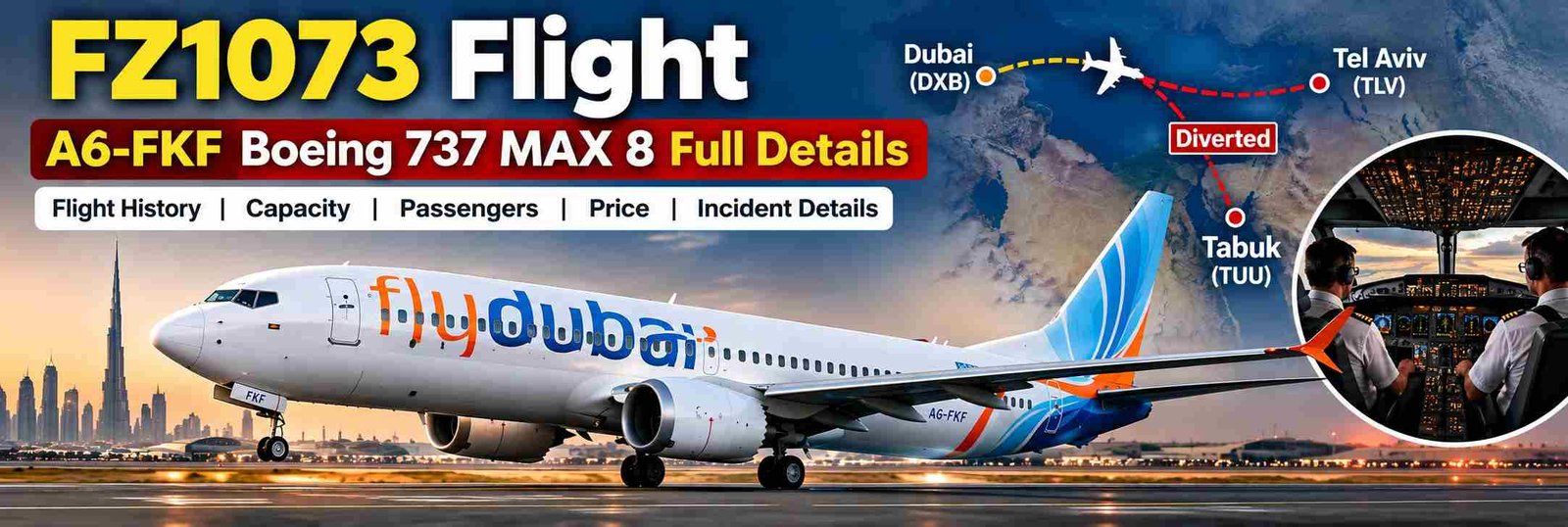
The September 30, 2026 incident involving flydubai Flight FZ1073 brought significant international attention to the airframe involved: a modern Boeing 737 MAX 8 registered as A6-FKF. Contrary to initial public speculation regarding fleet aging or mechanical wear, available airframe registries indicate that the aircraft was a relatively new build operating standard, high-tempo commercial rotations.
Airframe Specifications & Core Identity
The aircraft, manufactured by Boeing at its Renton, Washington facility, was formally handed over to flydubai in December 2022 following standard delivery staging via Shannon (SNN) to Dubai (DXB).
| Parameter | Technical Details |
|---|---|
| Aircraft Model | Boeing 737-8 MAX (B38M) |
| Registration | A6-FKF |
| Manufacturer Serial Number (MSN) | 61013 |
| Line Number | 8422 |
| Operator | flydubai (United Arab Emirates) |
| Engines | 2 × CFM International LEAP-1B |
| Date of Manufacture | 2022 |
| Delivery Date | December 2022 |
| Age at Incident | ~3 years, 9 months |
| Mode-S Transponder Code | 8965D1 |
| Cabin Layout | 174 Seats (12 Business Class, 162 Economy) |
| Current Operational Status | Parked / Grounded post-incident (Tabuk, TUU) |
Operational History & Fleet Utilization
Following its introduction in late 2022, A6-FKF served as a primary short-to-medium haul workhorse across flydubai’s regional network connecting the Gulf, South Asia, Europe, and the Middle East.
- Cumulative Flight Sectors: Tracking platforms recorded approximately 5,700 sectors between delivery and September 30, 2026. (Note: This metric reflects observed tracking movements rather than official OEM airframe flight cycle logs).
- Theoretical Seat Volume: At full capacity across 5,700 sectors ($5,700 \times 174$), the airframe offered roughly 991,800 theoretical seat sectors. Accounting for average regional passenger load factors (~75–85%), the estimated unique passenger count is approximately 740,000 to 840,000 travellers.
- Pre-Incident Aircraft Utilization (September 29–30, 2026):
- Mineralnye Vody (MRV) $\rightarrow$ Dubai (DXB)
- Dubai (DXB) $\rightarrow$ Sulaimaniyah (ISU) $\rightarrow$ Dubai (DXB)
- Dubai (DXB) $\rightarrow$ Doha (DOH) $\rightarrow$ Dubai (DXB)
- Dubai (DXB) $\rightarrow$ Tel Aviv (TLV) — Departed morning of September 30, 2026 as FZ1073
Prior to September 30, 2026, aviation safety databases (such as AeroInside and ASN) recorded no major incidents, structural damage events, or airworthiness directives non-compliances specifically tied to airframe A6-FKF.
Flight FZ1073: In-Flight Emergency & Flight Profile
On September 30, 2026, Flight FZ1073 departed Dubai International Airport (DXB) en route to Ben Gurion Airport (TLV), Tel Aviv, carrying 174 passengers and 6 crew members (180 total occupants).
   FL340 (Cruise)
   ────────────\
                \  Rapid Uncontrolled Descent / Altitude Excursion
                 \  (~15,000–19,000 ft Level-off)
                  \──────────────────────────────\
                                                  \  Diversion to Tabuk (TUU)
                                                   \─────────────── [Safe Touchdown]
Transponder squawks and trajectory deviations:
- Cruising Phase: Aircraft stabilized at FL340 (34,000 feet) over Saudi airspace.
- Cockpit Incident: Preliminary reporting indicated an acute physical confrontation occurred between the flight crew members inside the flight deck, impairing manual flight management and primary flight control inputs.
- Squawk Sequence:
- The aircraft’s Mode-S transponder transmitted Squawk 7700 (General In-Flight Emergency).
- The code was subsequently updated to Squawk 7500 (Unlawful Interference / Flight Deck Compromise).
- Descent & Aerodynamic Recovery: The aircraft experienced an abrupt altitude drop from FL340, stabilizing between 15,000 and 19,000 feet. ADS-B telemetry gaps during the maneuver limited direct public verification of exact instantaneous sink rates (VSI).
- Diversion & Landing: Air traffic control cleared an immediate emergency diversion to Tabuk Regional Airport (TUU), Saudi Arabia, where the aircraft completed an overweight/emergency landing without fatalities.
Technical Grounding & Damage Assessment
Following touchdown in Tabuk:
- Airframe Stress & Over-G Inspection: Initial assessments noted substantial damage consistent with either severe aerodynamic overstress during the rapid descent or an aggressive overweight landing roll-out.
- Grounded Status: A6-FKF was secured on the apron at Tabuk. A joint safety inquiry involving the UAE General Civil Aviation Authority (GCAA), Saudi aviation authorities, the air carrier, and independent investigative bodies was initiated to evaluate:
- Digital Flight Data Recorder (DFDR) and Cockpit Voice Recorder (CVR) readouts.
- Structural airframe integrity (wing root attachments, empennage, and landing gear trunnions).
- Crew mental health monitoring and flight deck security protocols.
Frequently Asked Questions (FAQ)
1. Which aircraft was operating flight FZ1073?
The flight was operated by a Boeing 737-8 MAX, registered as A6-FKF, operated by UAE-based low-cost carrier flydubai.
2. How old was aircraft A6-FKF on the day of the incident?
A6-FKF was delivered new from Boeing in December 2022. On September 30, 2026, the aircraft was approximately 3 years and 9 months old.


3. What was the seating configuration of A6-FKF?
It was configured with 174 passenger seats: 12 recliner/lie-flat Business Class seats and 162 standard Economy Class seats.
4. How many flights had A6-FKF logged before the incident?
Commercial tracking records indicate roughly 5,700 individual flight sectors flown across its service history.
5. How many total passengers flew on this specific jet?
While total capacity across 5,700 flights equals roughly 991,800 available seat-trips, the actual number of carried passengers is estimated between 740,000 and 840,000 based on standard regional load factors.
6. Did A6-FKF have any prior accidents before September 30, 2026?
No. Individual airframe records indicate a standard operational history with no previous structural damage or notable safety incidents.
7. Is this incident related to the 2018–2019 Boeing 737 MAX groundings?
No. The 2018–2019 groundings involved the Maneuvering Characteristics Augmentation System (MCAS) and angle-of-attack sensor data integration. A6-FKF was built in 2022, long after the global fleet was cleared with updated flight control computer software and dual-sensor verification.
8. What initiated the in-flight emergency on FZ1073?
Preliminary data pointed to an acute physical conflict inside the cockpit between the flight crew, resulting in flight path destabilization and the transmission of transponder codes 7700 (Emergency) and 7500 (Unlawful Interference).
9. Why did the flight divert to Tabuk (TUU)?
Tabuk Regional Airport in northwestern Saudi Arabia was the closest adequately equipped diversion airfield capable of accepting a medium-haul commercial jet descending rapidly from cruising altitude.
10. What is the current disposition of A6-FKF?
The airframe remains grounded at Tabuk pending structural inspections for aerodynamic/landing overstress, maintenance sign-offs, and final regulatory safety clearance.
