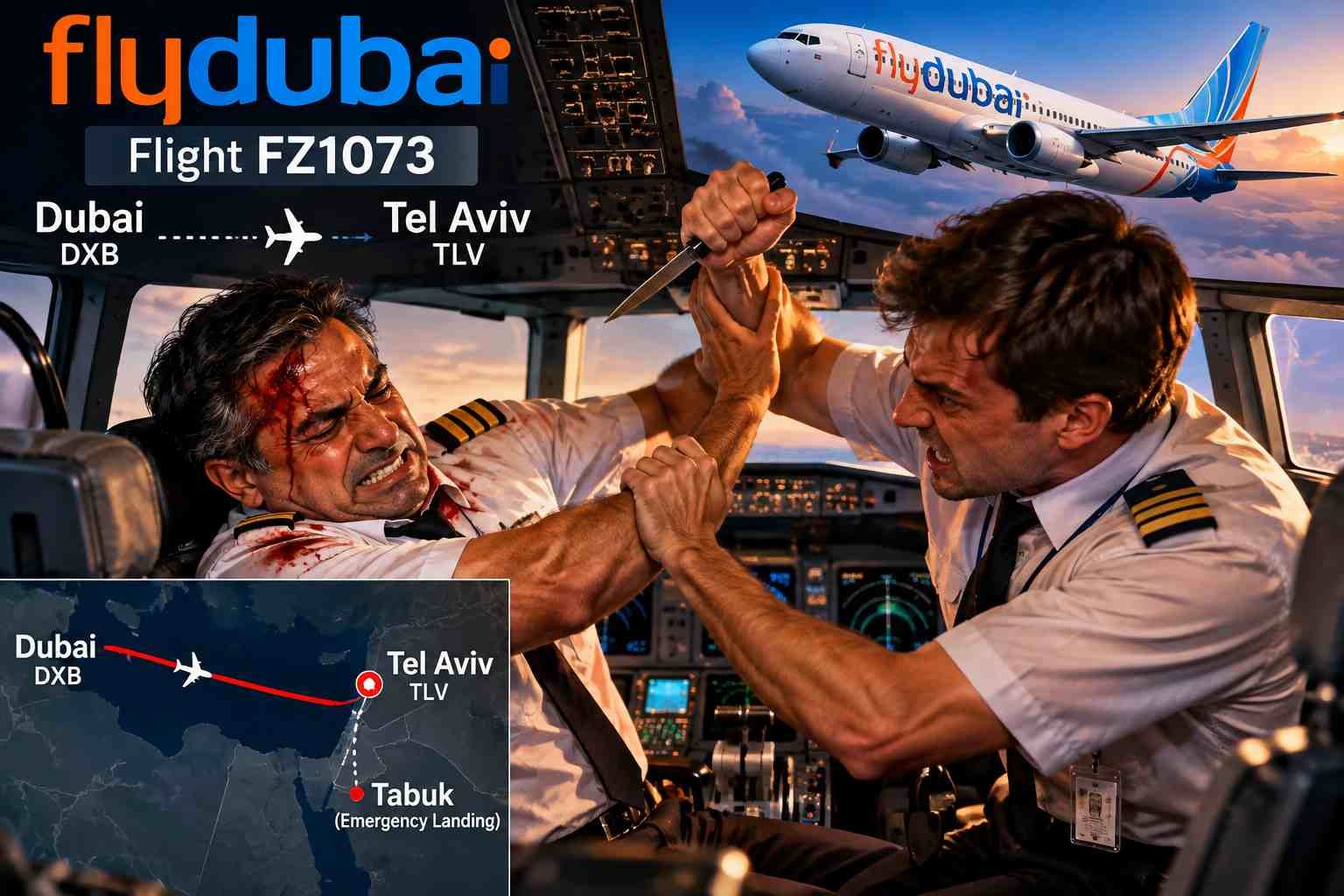
October 2, 2026 — At 3:05 AM GMT on September 30, 2026, a Boeing 737 MAX 8 lifted off from Dubai International Airport, bound for Tel Aviv. Ninety minutes later, its captain would be fighting for his life inside a locked cockpit, the aircraft plunging toward the desert below, and the fate of 174 people hanging on whether anyone could get through the reinforced flight deck door in time .
This is the complete timeline of flydubai Flight FZ1073.
1. The Crew, the Aircraft, and the Passengers
The aircraft was registered A6-FKF, a Boeing 737 MAX 8 operated by flydubai, the low-cost carrier based in Dubai . In command was Captain Smit Machchhar, a 30-something Indian national from Ghatkopar East in Mumbai . By September 2026, Machchhar had accumulated more than 9,750 hours of flying experience, including over 6,400 hours as pilot-in-command. He joined flydubai in 2022 after six years at India’s SpiceJet, following initial flight training at Mainland Air in Dunedin, New Zealand .
Serving as first officer was an Omani national whose name has not been officially released by UAE authorities. He was seated in the right seat of the cockpit .
Aboard the flight were 174 passengers, according to Saudi airport authorities . Israeli Prime Minister Benjamin Netanyahu later stated that “almost all” passengers were Israeli citizens . Among the passengers were two off-duty flydubai pilots traveling in the cabin — a detail that would prove decisive .
The flight’s scheduled route was straightforward: Dubai to Ben Gurion International Airport near Tel Aviv, a flight of roughly three and a half hours across Saudi Arabia and Jordan .
2. Routine Departure, Routine Cruise
Flightradar24 data shows FZ1073 departed Dubai at 03:05 GMT (07:05 local UAE time) and climbed to a cruising altitude of approximately 34,000 feet . For the first two and a half hours, the flight proceeded without incident across Saudi Arabian airspace .
At this point, nothing suggested the flight would become one of the most dramatic aviation security incidents in years.
3. The Cockpit Attack
At approximately 05:21 GMT, the aircraft suddenly began a series of violent altitude changes . Flightradar24 data recorded the Boeing 737 MAX 8 leaving its 34,000-foot cruise in a steep descent, dropping more than 14,000 feet in less than 30 seconds . Some tracking data later indicated a drop of up to 17,000 feet in under two minutes .
The cause, according to Israeli officials and subsequent investigations, was an attack inside the cockpit. The Omani co-pilot stabbed Captain Machchhar, inflicting serious injuries . According to a spokesperson for Israeli Prime Minister Netanyahu, the co-pilot “apparently attempted to crash the aircraft” .


Intelligence sources cited by CNN-News18 later described the attack as a “calculated, 9/11-style terror plot” aimed at incapacitating the captain and forcing the aircraft into a fatal dive targeting population centers in Israel, specifically Tel Aviv or Jerusalem . This characterization has not been officially confirmed by UAE or Israeli authorities, and the formal investigation remains ongoing.
4. Terror at 33,000 Feet
Inside the cabin, passengers experienced sudden, violent movements. Passenger Almog Italie told media the aircraft “appeared to fall for about 20 to 30 seconds before stabilizing and descending again” .
Another passenger, Dalia Shpigel, 74, described to Israeli newspaper Haaretz that the aircraft “suddenly began losing altitude” and that “terrible screams” were heard throughout the cabin . Passengers began shouting about a stabbing and blood .
At 05:22 GMT, Flightradar24 data confirmed the aircraft had dropped by more than 14,000 feet. The aircraft briefly climbed, then descended again, and by approximately 05:33 GMT had stabilized near 15,000 feet .
5. The Captain’s Act
Despite being seriously wounded, Captain Machchhar managed to activate the release mechanism for the reinforced cockpit door . This was the critical moment of the crisis.
Passengers and crew members who had been alerted by the screams rushed to the cockpit. According to passenger accounts, “three to five guys burst into the cockpit” and subdued the attacker . Video recorded aboard the plane later showed injured men being treated and passengers guarding the cockpit area .
The two off-duty flydubai pilots traveling as passengers reached the flight deck after the attacker was restrained. According to passenger accounts, they took control of the aircraft, raised it from its descent, and stabilized it before beginning the diversion to Saudi Arabia .
6. The Emergency Signals
The transponder sequence transmitted from FZ1073 told its own story of escalating crisis.
At approximately 05:28 GMT, the aircraft began transmitting squawk code 7700 — the internationally recognized signal for a general emergency . This alerts air traffic controllers that an aircraft requires priority handling but does not specify the nature of the emergency .
Minutes later, the code changed to 7500 — the signal for unlawful interference, the universal code for a possible hijacking . This transmission triggered maximum alert protocols. Israeli fighter jets were scrambled, and Prime Minister Netanyahu convened an urgent security consultation .


The aircraft turned west, briefly entered Jordanian airspace, then executed a 180-degree turn toward Saudi Arabia, returning to squawk 7700 .
7. Landing at Tabuk
At approximately 07:00 GMT (10:00 AM Israel time), the aircraft landed safely at Tabuk Airport in northwestern Saudi Arabia .
flydubai confirmed the landing, stating that all passengers were safe and accounted for . The UAE General Civil Aviation Authority (GCAA) described the episode as a “security incident” that was brought under control, noting that some crew members were injured and transported to a hospital in Saudi Arabia .
Israeli officials stated that the co-pilot had stabbed the captain and “apparently attempted to crash the aircraft” . Saudi authorities took the co-pilot into custody for questioning .
8. The Aftermath
The passengers remained at Tabuk for approximately eight hours before a replacement flydubai aircraft arrived to transport them to Israel . They landed at Ben Gurion International Airport later that day .
Captain Machchhar received initial medical treatment in Tabuk before being transferred to Abu Dhabi for continued care . India’s Ambassador to the UAE, Dr. Deepak Mittal, met with Machchhar and his family and reported that the captain was “in good spirits,” “speaking openly, smiling and laughing” .
The Omani co-pilot remained in Saudi custody pending the completion of the initial investigation. According to an Israeli official cited by The Times of Israel, he was expected to be handed over to UAE authorities once Saudi Arabia concluded its questioning .
9. Investigations and Unanswered Questions
Multiple investigations were launched in the days following the incident.
The UAE Prosecutor General ordered an investigation to determine “the extent of the connection between this incident and any terrorist act or intent” . The GCAA stated its investigation teams were working to determine the causes and circumstances of the incident . Saudi Arabia conducted the initial questioning of the suspect . Israeli security agencies were also examining possible links and the circumstances surrounding the attack .
As of October 2, 2026, no motive had been established . Israeli Prime Minister Netanyahu stated that investigators would seek to determine whether there was any wider involvement, but no direct link to Iran or any other organization had been established . When asked by Fox News whether there were indications of Iranian involvement, Netanyahu replied that it was “too early to determine” .

A report by Israel’s Channel 12 revealed that Shin Bet chief David Zini had warned for months that security arrangements on flights arriving from the UAE were insufficient, and that the agency had been involved in a dispute with Israeli airlines over security measures on UAE routes in the weeks preceding the incident .
10. The Hero of FZ1073
Captain Smit Machchhar’s actions were praised by leaders across the world. Israeli Prime Minister Netanyahu wrote on X that Machchhar “saved the lives of 174 people” and prevented “a catastrophic mid-air disaster.” Netanyahu called him a “true hero” .
Indian Prime Minister Narendra Modi and US President Donald Trump also hailed the Indian pilot . Israeli President Isaac Herzog announced that four Israeli citizens who helped subdue the co-pilot would receive a bravery award .
Those who knew Machchhar were not surprised. Captain Dharav Gosalia, a friend and former colleague at SpiceJet, described him as “outgoing,” “very jovial,” and a “disciplined flier.” Gosalia noted that Machchhar had undergone years of training, including “chair flying” — rehearsing emergency procedures mentally until they become instinctive .
“What happened to him, what he did — he was the commander on the flight,” Gosalia said. “There is no conventional checklist for another person trying to overpower you in the cockpit. How much courage plays a role? A lot. This was a threat to life” .
In a podcast interview recorded before the incident, Machchhar had reflected on his unlikely path to aviation. He had originally planned to join his family’s textile business, studying textile engineering and then management. An aviation seminar at age 19 changed everything .
“Aviation was not a childhood dream,” he said. “It came much later in life” .
He also recalled that his mother was initially scared of his career choice. “Because aviation today and aviation 15-17 years ago was completely different. You did not hear of a lot of people becoming pilots. So that was one thing that scared mom. The second, of course, was flying” .
At the time of that interview, Machchhar said no plane he had flown had ever needed to make an emergency landing .
11. What We Know, What We Don’t
Confirmed facts:

- A physical altercation occurred in the cockpit of FZ1073 involving the captain and first officer .
- Captain Smit Machchhar, an Indian national, was stabbed and injured .
- The co-pilot is an Omani national, taken into custody in Saudi Arabia .
- The aircraft transmitted squawk codes 7700 and 7500 .
- Two off-duty flydubai pilots aboard as passengers helped regain control .
- The aircraft landed safely at Tabuk, Saudi Arabia, with all 174 passengers safe .
Under investigation:
- The exact motive behind the attack .
- Whether there was any terrorist organization involvement or prior planning .
- How the co-pilot bypassed security screening with a weapon .
- Whether security protocols for UAE-Israel routes need revision .
The cockpit voice recorder and flight data recorder will be critical to establishing the precise sequence of events inside the flight deck .
12. Why This Matters
The FZ1073 incident raises profound questions about cockpit security in commercial aviation. The reinforced door that protects pilots from hijackers became, in this case, a barrier that trapped a wounded captain with his attacker. Only Machchhar’s ability to activate the door release while injured allowed help to reach him .
The incident also highlights the unique security challenges of flights between the UAE and Israel — two countries with normalized relations but operating within a volatile regional security environment. The Shin Bet’s prior warnings about insufficient security on UAE routes suggest the vulnerability was known before the attack .
For flydubai, the incident is a reputational test. The airline has urged against premature speculation and emphasized its cooperation with authorities .
For Captain Smit Machchhar, the episode transformed a routine flight into a defining moment. In the podcast recorded before the attack, he had offered simple advice: “Give personal life equal importance — it will help you fly longer” . On September 30, 2026, he demonstrated something else entirely: what it means to fight for your passengers when there is no checklist for the unimaginable.
FAQ 1: What exactly happened on flydubai Flight FZ1073?
Answer: On September 30, 2026, flydubai Flight FZ1073 from Dubai to Tel Aviv experienced a violent cockpit attack mid-flight. An Omani co-pilot stabbed the Indian captain, Smit Machchhar, and attempted to seize control of the aircraft, causing it to plunge over 14,000 feet in under 30 seconds . Despite serious injuries, Captain Machchhar managed to open the reinforced cockpit door, allowing passengers and off-duty pilots to rush in and subdue the attacker. The aircraft landed safely in Tabuk, Saudi Arabia, with all 174 passengers unharmed .
FAQ 2: Who is the pilot Smit Machchhar and what did he do?
Answer: Captain Smit Machchhar is an Indian national from Mumbai with over 13 years of commercial flying experience and approximately 9,750 flight hours, mostly on Boeing 737 aircraft . He joined flydubai in June 2022 after more than 11 years with SpiceJet . During the attack, despite being stabbed and bleeding heavily, Machchhar fought back, activated the cockpit door release, and enabled passengers to intervene . Israeli Prime Minister Benjamin Netanyahu called him a “true hero” who “saved the lives of 174 people” .
FAQ 3: Who was the attacker and what is his background?
Answer: The attacker was an Omani national serving as the co-pilot on Flight FZ1073 . He had been with flydubai for approximately eight months . A colleague described him as a “religious extremist” who “prayed excessively” and “refused to shake hands with women” . Israeli Prime Minister Netanyahu stated that the co-pilot had undergone “Islamist radical indoctrination” and exhibited suicidal behavior, reportedly shouting “kill me, kill me” after being restrained . An Israeli official also claimed the co-pilot’s social media accounts contained content about “killing Jews” .
FAQ 4: How did the passengers and crew stop the attacker?
Answer: After Captain Machchhar managed to open the cockpit door, several passengers rushed into the flight deck to confront the attacker . Yaniv Hayun, a plumber, pulled the attacker away from the controls and helped stabilize the aircraft . Zvika Manes, a banker, helped restrain the attacker using headphone cords and plastic zip ties . Shota Musaev, a dentist, provided emergency medical aid to the wounded captain . Two off-duty flydubai pilots traveling as passengers also entered the cockpit and took control of the aircraft, stabilizing it before the diversion .

FAQ 5: What emergency codes did the aircraft transmit?
Answer: The aircraft transmitted two critical emergency transponder codes during the incident. At approximately 05:28 GMT, it sent squawk 7700, the international signal for a general emergency . Minutes later, it switched to squawk 7500, the code for unlawful interference or a possible hijacking . US Senator and commercial pilot Tim Sheehy suggested that Captain Machchhar may have manually changed these codes while fighting off the attacker, as he was the only person in the cockpit capable of doing so at that moment .
FAQ 6: Where did the flight land and what happened to the passengers?
Answer: The aircraft landed safely at Tabuk Airport in northwestern Saudi Arabia at approximately 07:00 GMT . All 174 passengers were safe and accounted for . Passengers remained in Tabuk for approximately eight hours before a replacement flydubai aircraft transported them to Israel . Captain Machchhar was initially treated in Saudi Arabia before being airlifted to Abu Dhabi for further medical care .
FAQ 7: What is the current medical condition of Captain Smit Machchhar?
Answer: Captain Machchhar underwent emergency surgery in Saudi Arabia and was later airlifted to Abu Dhabi for advanced medical treatment . The Indian Ambassador to the UAE, Deepak Mittal, visited him and reported that Machchhar was “in good spirits” and recovering well . His family traveled from Mumbai to be with him . The Gujarat government announced the Vishisht Gujarat Garima Award and ₹25 lakh (2.5 million rupees) in recognition of his bravery .
FAQ 8: What investigations have been launched?
Answer: Multiple investigations are underway. The UAE Attorney-General ordered a specialized investigation to determine whether the incident was linked to “terrorist activity or intent” or involved “prior planning or direction” . Saudi Arabia’s National Transport Safety Center conducted preliminary questioning of the suspect . The suspect is expected to be handed over to UAE authorities for further investigation, with Israeli investigators participating . The aircraft’s cockpit voice recorder and flight data recorder will be critical to establishing the exact sequence of events .
FAQ 9: What are the security implications of this incident?
Answer: The attack raised serious questions about cockpit security and pilot vetting procedures. Israeli Prime Minister Netanyahu noted a “loophole” that allowed an Omani pilot—from a country with no diplomatic relations with Israel—to operate a flight to Israel . Shin Bet chief David Zini had reportedly warned for months that security arrangements on flights from the UAE were insufficient . flydubai temporarily suspended all flights to and from Israel following the incident .
FAQ 10: How has the world reacted to Captain Machchhar’s actions?
Answer: Captain Machchhar has been praised by leaders worldwide. Israeli Prime Minister Netanyahu called him a “true hero” who prevented a “9/11-style catastrophe” . Indian Prime Minister Narendra Modi hailed him as a “HERO” . US President Donald Trump also praised Machchhar’s actions . Israel’s Ambassador to India, Reuven Azar, said: “Thanks to the courage of the captain, the crew and the passengers, terrorism has failed” . Israeli President Isaac Herzog announced that four Israeli passengers who helped subdue the attacker will receive a bravery award .
Why the Name Is Withheld
According to Al Jazeera, “very little verified information has come through so far” regarding the attacker’s identity . Officials have urged the public to refrain from speculation as investigations continue.
The only confirmed names in this incident are Captain Smit Machchhar (the Indian pilot who was attacked) and the heroic passengers who subdued the attacker, such as Yaniv Hayun, Zvika Manes, and Shota Musaev.
