🌍 2026 Global Heat Crisis: Europe vs. India & World Temperature Records
🥵 As the planet warms, Europe and India face scorching heat — but for very different reasons. This data-rich blog compares the 2026 heatwaves, explores why 43°C feels worse in Europe, and lists the hottest temperatures ever recorded across the globe.
🔥 Introduction: A World Under Heat
The year 2026 is a defining moment in the global climate crisis. While the West feels the true effects of climate change for the first time, Europe is baking under a relentless heat dome, and India — long accustomed to scorching summers — faces its own escalating temperature challenges. The ongoing Super El Niño has intensified these conditions, leading to droughts and hotter weather worldwide.
This comprehensive analysis explores why similar temperatures on a thermometer can mean dramatically different things across continents, examines which countries hold the world’s highest temperature records, and reveals what India and Europe can learn from each other in heat preparedness.
📊 Europe Heatwave vs. India Heat (2026) — Comparison
| Factor | 🇪🇺 Europe (June–July 2026) | 🇮🇳 India (Summer/Monsoon 2026) |
|---|---|---|
| 🌡️ Main Cause | Persistent high-pressure “heat dome” / Omega Block trapping hot air | Pre-monsoon heating, delayed monsoon, hot continental winds (Loo) |
| 🌬️ Hot Air Source | Very hot air moving north from North Africa (Sahara) | Desert air from the Thar Desert and dry inland regions |
| 🌍 Climate Change Impact | Strongly intensified; would have been nearly impossible 50 years ago | Increasing frequency and intensity of heatwaves |
| 📈 Typical Maximum | 38–43°C (some places above 44°C) | 42–48°C in north and central India during peak summer |
| 🏗️ Preparedness | Homes, schools, transport designed for cold weather, not extreme heat | More accustomed to hot summers, though heat still causes major health risks |
| 🏥 Healthcare Response | Stronger coordination and surge planning across regions | Experience-based response but faces resource constraints |
| 🏠 Building Design | Wooden floors, dark roofs that trap heat; insulation retains warmth | Stone or tiled floors; designs reflect some heat adaptation |
| ❄️ Air Conditioning | Historically minimal (less than 7 hot days/year); rapidly increasing | More common in urban areas but still inaccessible for millions |
| 🌳 Urban Green Cover | London tree canopy ~20% | Delhi green cover ~23% (higher than London!) |
| 🏛️ Heat Action Plans | Many countries only now writing heat plans | Ahmedabad pioneered South Asia’s first Heat Action Plan in 2013; model replicated across India |
❓ Why Does 43°C in Europe Feel Worse Than 43°C in India?
- Geographical Position & Sun Angle: Europe lies farther north; sunlight falls at an angle, and summer days are much longer, changing how the sun feels on the skin.
- Air Quality & Sun Sharpness: India’s air pollution dulls the sun somewhat; Europe’s clearer skies make the sun feel stronger.
- Wind Conditions: European heatwaves have been marked by little to no wind, making the air feel still and suffocating.
- Building Design: European homes feature wooden floors and dark roofs that trap heat; Indian homes often have stone or tiled floors that stay cooler.
- Lack of Air Conditioning: Most European homes were built without AC since hot days were rare — this is now changing rapidly.
- Infrastructure Vulnerabilities: European roads use bitumen that softens at 40°C, causing melting. India uses harder-grade bitumen for 45–50°C.
- Acclimatization: Europeans are less acclimatized to prolonged extreme heat, making physiological responses more severe.
🏆 Global Temperature Records: World’s Hottest Countries
The Official World Record
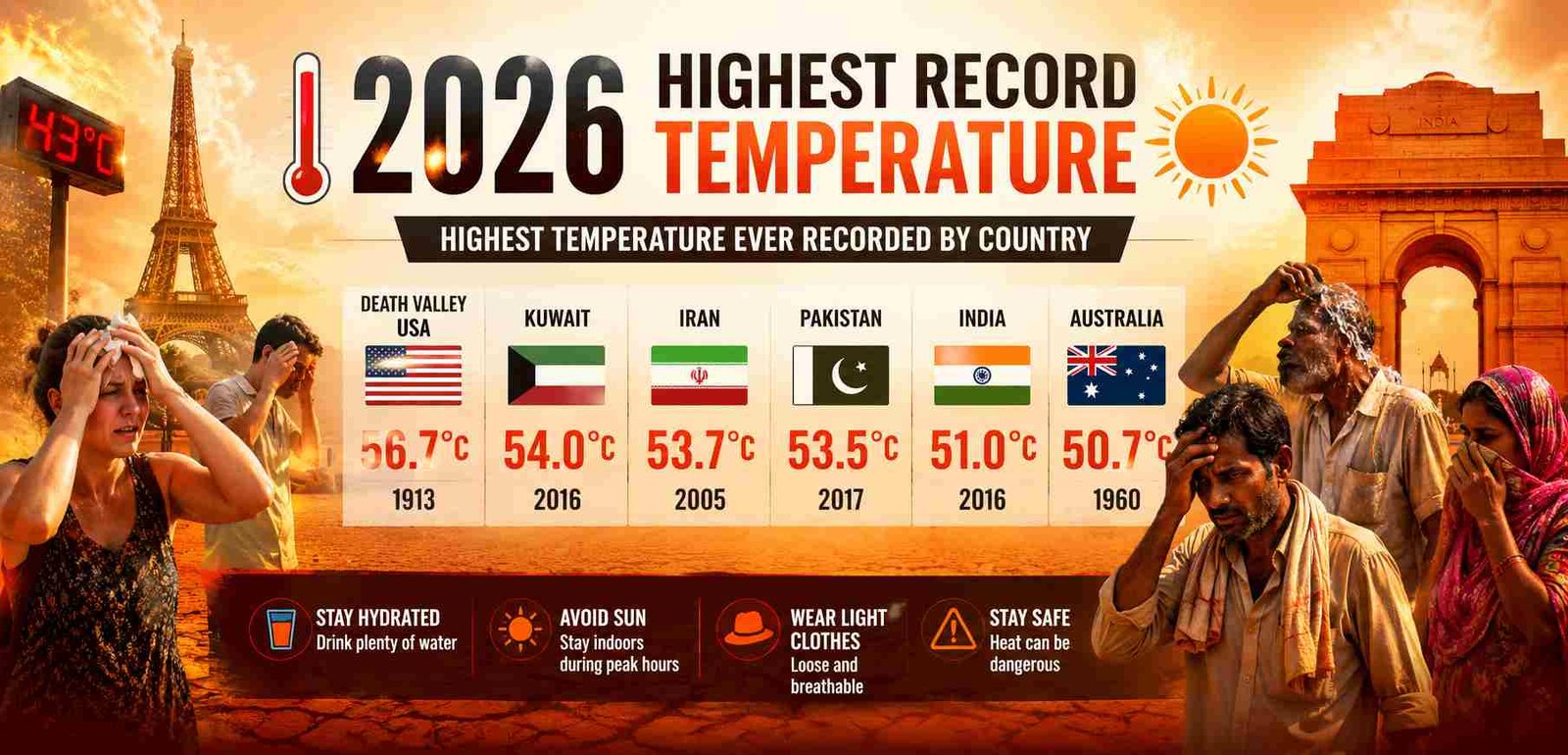
The United States holds the highest officially recognized air temperature ever measured: 56.7°C (134.1°F) at Furnace Creek in California’s Death Valley, recorded on July 10, 1913. The previous record of 58.0°C from El Azizia, Libya (1922) was officially decertified in 2011 due to thermometer errors.
World’s 20 Highest National Temperature Records
| Rank | Country | Temperature | Location | Year |
|---|---|---|---|---|
| 1 | 🇺🇸 United States | 56.7°C (134.1°F) | Death Valley, California | 1913 |
| 2 | 🇹🇳 Tunisia | 55.0°C (131.0°F) | Kebili | 1931 |
| 3 | 🇰🇼 Kuwait | 54.0°C (129.2°F) | Mitribah, Al Jahra Governorate | 2016 |
| 4 | 🇮🇱 Israel | 54.0°C (129.2°F) | Tirat Zvi | 1942 |
| 5 | 🇮🇶 Iraq | 53.9°C (129.0°F) | Basra | 2016 |
| 6 | 🇵🇰 Pakistan | 53.7°C (128.7°F) | Turbat | 2017 |
| 7 | 🇮🇷 Iran | 53.7°C (128.7°F) | Ahvaz Airport | 2017 |
| 8 | 🇨🇳 China | 52.2°C (126.0°F) | Turpan, Xinjiang | 2023 |
| 9 | 🇦🇪 UAE | 52.1°C (125.8°F) | Sweihan, Al Ain | 2002 |
| 10 | 🇲🇽 Mexico | 52.0°C (125.6°F) | San Luis Río Colorado, Sonora | 1966 |
| 11 | 🇸🇦 Saudi Arabia | 52.0°C (125.6°F) | Jeddah | 2010 |
| 12 | 🇴🇲 Oman | 51.6°C (124.9°F) | Joba | 2021 |
| 13 | 🇩🇿 Algeria | 51.3°C (124.3°F) | El Bayadh, Ouargla Province | 1979 |
| 14 | 🇪🇬 Egypt | 51.1°C (124.0°F) | Aswan and Asyut | 1918 |
| 15 | 🇯🇴 Jordan | 51.1°C (124.0°F) | Deir Alla | 2010 |
| 16 | 🇮🇳 India | 51.0°C (123.8°F) | Phalodi, Rajasthan | 2016 |
| 17 | 🇦🇺 Australia | 50.7°C (123.3°F) | Oodnadatta, Western Australia | 1960 |
| 18 | 🇹🇷 Türkiye | 50.5°C (122.9°F) | Silopi, Şırnak Province | 2025 |
| 19 | 🇲🇦 Morocco | 50.4°C (122.7°F) | Agadir (Inezgane Airport) | 2023 |
| 20 | 🇶🇦 Qatar | 50.4°C (122.7°F) | Doha | 2010 |
Continental Temperature Records
Recent Record-Breaking Events
🤝 What India and Europe Can Learn From Each Other
🇮🇳 India’s Strengths: Experience and Action Plans
- Ahmedabad Heat Action Plan (2013): South Asia’s first comprehensive heat plan, created after a 2010 heatwave killed more than 1,300 people.
- Three core strategies: Early Warning & Alert Systems, public awareness, medical and infrastructure preparedness.
- The model has been replicated across Indian cities and other South Asian countries.
- “Much of Europe is only writing these plans now,” notes climate expert Ruchir Punjabi.
🇪🇺 Europe’s Strengths: Health Infrastructure
- Stronger healthcare systems and emergency response.
- Better at surge planning in hospitals.
- More effective coordination of health responses across regions.
🔑 Key Insights for Better Heat Preparedness
- Urban Planning: More tree cover, shaded public spaces, cooler buildings, restored water bodies.
- Measuring Impact: Track whether interventions actually lower heat exposure for vulnerable populations.
- Health Systems: Treat heat as a major public health issue, not just weather.
- Infrastructure: Design for both heat and cold extremes.
- Vulnerable Populations: Protect outdoor workers, elderly, and low-income communities.
🌡️ Why This Matters: The Bigger Picture
What is happening in Europe is an indication that extreme heat is becoming more frequent, intense, and prolonged worldwide. “For India, it signals hotter summers, longer heatwaves, greater water stress, and increased health risks. What is exceptional today may become normal tomorrow,” warns climate scientist Prof. (Dr.) Sanjay Kumar.
The old assumption that extreme heat was only a problem for “poorer, hotter” parts of the world has been shattered. When temperate, wealthy Europe starts recording these temperatures, the lesson is clear: heat adaptation must be global.
📝 Conclusion
While India often records higher absolute temperatures, Europe’s 2026 heatwave is exceptional because it is far above its normal climate, caused by a persistent atmospheric blocking pattern amplified by human-driven climate change, and affecting infrastructure and populations less adapted to such extreme heat.
The data shows that the Middle East, North Africa, and South Asia dominate global temperature records, with Kuwait, Iraq, Iran, and Pakistan among the hottest countries. The United States retains the official world record from Death Valley in 1913, though recent record-breaking events across Canada, China, Morocco, and Turkey indicate that the climate crisis is accelerating.
Bottom Line: Similar thermometer readings can mean very different things depending on geography, infrastructure, societal preparedness, and climate context. As global temperatures continue to rise, every nation must prepare for the heat to come.
❓ Top 10 Frequently Asked Questions (FAQs)
© 2026 — Data compiled from World Meteorological Organization & national meteorological services



🇮🇳 इस लेख को हिन्दी में पढ़ना चाहते हैं?
📖 Continue Reading in Hindi →