Iran Missile Range 2026: Complete Capability Analysis
🔥 Iran’s missile capabilities in 2026 represent a paradigm shift in Middle Eastern security. From short-range tactical systems to emerging intermediate-range ballistic missiles approaching 4,000 km, Tehran has built one of the most diverse and powerful missile arsenals in the world.
The March 2026 attack on Diego Garcia — a joint US-UK base located 3,800 km from Iranian territory — shattered previous assumptions about Iran’s maximum range and demonstrated a new strategic reality.
This comprehensive FAQ covers everything you need to know about Iran’s missile ranges, capabilities, and strategic implications in 2026.
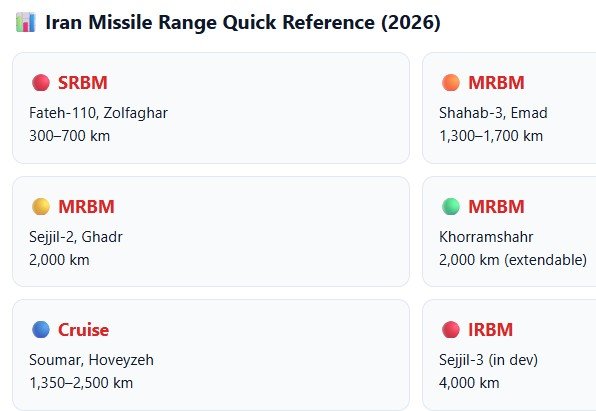
📊 Iran Missile Range Quick Reference (2026)
🔴 SRBM Fateh-110, Zolfaghar
300–700 km
300–700 km
🟠 MRBM Shahab-3, Emad
1,300–1,700 km
1,300–1,700 km
🟡 MRBM Sejjil-2, Ghadr
2,000 km
2,000 km
🟢 MRBM Khorramshahr
2,000 km (extendable)
2,000 km (extendable)
🔵 Cruise Soumar, Hoveyzeh
1,350–2,500 km
1,350–2,500 km
🔴 IRBM Sejjil-3 (in dev)
4,000 km
4,000 km
Frequently Asked Questions
What is the maximum range of Iran’s missiles in 2026?
Iran’s maximum confirmed missile range in 2026 is 3,800–4,000 kilometers, demonstrated by the March 2026 attack on Diego Garcia. While Iran officially claims a 2,000 km limit, operational capabilities now extend to 4,000 km with emerging systems like the Sejjil-3 and modified Khorramshahr variants. Iran is also reportedly developing the Khorramshahr-5 with a claimed 12,000 km range.
Which Iranian missiles can reach Israel?
Multiple Iranian missiles can reach Israel including the Shahab-3 (1,300 km), Emad (1,700 km), Ghadr (2,000 km), Sejjil-2 (2,000 km), and Khorramshahr (2,000 km). All of Israel is within range of Iran’s operational medium-range ballistic missiles. The Sejjil-2, with its solid-fuel propulsion and unpredictable ‘dancing missile’ trajectory, is specifically designed to penetrate Israeli air defenses like Arrow-3 and David’s Sling.
What happened in the Diego Garcia missile attack in March 2026?
On March 21, 2026, Iran launched two intermediate-range ballistic missiles targeting the joint US-UK military base at Diego Garcia in the Indian Ocean, located approximately 3,800–4,000 kilometers from Iranian territory. One missile failed during flight, while the second was intercepted by a US Navy SM-3 interceptor. Despite the failed strike, the attack was strategically significant as it demonstrated Iran’s capability to reach targets twice its declared maximum range.
What is the range of Iran’s Sejjil-2 and Sejjil-3 missiles?
The Sejjil-2 is a two-stage solid-fuel medium-range ballistic missile with an operational range of approximately 2,000 kilometers. It is known as the ‘dancing missile’ due to its unpredictable flight trajectory. The Sejjil-3, currently in development, is expected to be a three-stage solid-fuel missile with an estimated range of 4,000 kilometers, potentially placing all of Europe within striking distance.
What cruise missiles does Iran possess and what are their ranges?
Iran operates several cruise missile systems: Soumar (2,500 km) land-attack cruise missile, Hoveyzeh (1,350+ km) precision strike variant, Abu Mahdi (1,000+ km) with AI-assisted navigation, and Ghadr-380 (1,000 km). Cruise missiles fly below 50 meters altitude, making them difficult to detect by radar.
Can Iran’s missiles reach Europe?
Yes. With a 4,000 km range, Iranian missiles can reach every European country except Portugal. Major capitals within range include London (~4,000 km), Berlin (~3,500 km), Rome (~3,200 km), Vienna (~3,300 km), Athens (~2,200 km), and Bucharest (~2,500 km).
What is the difference between Iran’s liquid-fuel and solid-fuel missiles?
Liquid-fuel missiles like Shahab-3 and Khorramshahr require fueling before launch, taking several minutes and making them vulnerable to preemptive airstrikes. Solid-fuel missiles like the Fateh family and Sejjil-2 can be launched almost immediately, are more mobile, and enable rapid salvo launches against missile defense systems.
What is the range of Iran’s Fateh and Zolfaghar missiles?
The Fateh family includes: Fateh-110 (300 km), Fateh-313 (500 km), and Raad-500 (500 km). The Zolfaghar has an extended range of 700 km. These solid-fuel short-range ballistic missiles are highly accurate and target US bases in the Persian Gulf, GCC states, and maritime targets in the Strait of Hormuz.
Is Iran developing intercontinental ballistic missiles (ICBMs)?
In August 2025, Iranian media reported development of the Khorramshahr-5 with a claimed range of 12,000 kilometers — sufficient to reach the United States. While these claims remain unverified, Iran’s space launch vehicle program (Qaem 100, Simorgh) provides dual-use technology that can be adapted for ICBM development.
How has Iran’s missile range evolved over time?
Iran’s missile range has steadily expanded: 1980s: 300 km (Scud-B) → 1990s: 1,000 km (Shahab-2) → 2000s: 2,000 km (Shahab-3, Ghadr) → 2010s: 2,000 km precision (Emad, Sejjil-2) → 2026: 4,000 km (Diego Garcia attack). Key drivers include North Korean technology transfers, space launch vehicle development, and solid propellant advances.
🎯 Key Takeaways: Iran Missile Capability 2026
- Maximum confirmed range: 3,800–4,000 km (Diego Garcia attack, March 2026)
- Operational MRBM range: 2,000 km (Sejjil-2, Khorramshahr)
- Cruise missile range: up to 2,500 km (Soumar)
- Solid-fuel systems enable rapid launch and salvo attacks
- All of Israel, Turkey, Egypt, and most of Europe are within striking distance
- ICBM development remains a long-term strategic objective
