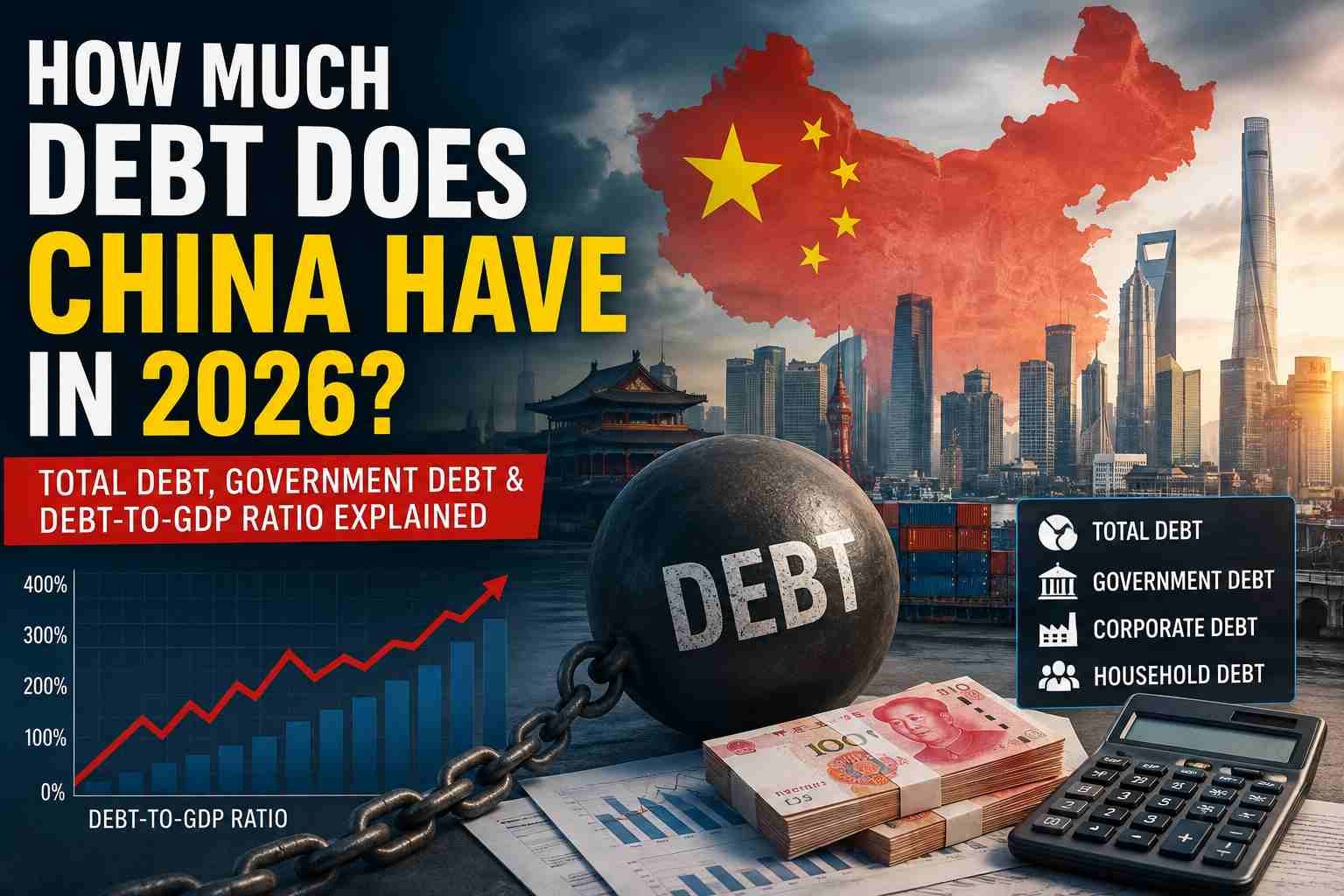
How much debt does China have? This is one of the most important questions in the global economy because China is the world’s second-largest economy and a major player in global trade, manufacturing and finance.
But there is a major problem with giving China’s debt as one simple number: China has government debt, household debt, corporate debt and local-government financing debt.
According to the latest IMF assessment published in February 2026, China’s economy had estimated nominal GDP of about 140.2 trillion yuan ($19.5 trillion) in 2025. The IMF estimated total non-financial-sector debt at 313% of GDP, while general government debt was estimated at 68.4% of GDP.
🇨🇳 China’s Debt at a Glance
| Debt category | 2025 estimate | Approximate amount |
|---|---|---|
| Government debt | 68.4% of GDP | ≈ ¥95.9 trillion |
| Augmented government debt | 126.6% of GDP | ≈ ¥177.5 trillion |
| Total non-financial-sector debt | 313% of GDP | ≈ ¥438.8 trillion |
| Total Social Financing | 315% of GDP | ≈ ¥441.6 trillion |
| Household debt | 59.4% of GDP | ≈ ¥83.3 trillion |
| Non-financial corporate debt | 122% of GDP | ≈ ¥171.0 trillion |
Figures are based on IMF 2025 estimates. Approximate yuan amounts are calculated from the IMF’s estimated 2025 nominal GDP of ¥140.188 trillion.
💰 So, How Much Debt Does China Actually Have?
The answer depends on what you count.
If you are talking specifically about government debt, the IMF estimates China’s general government debt at around 68.4% of GDP in 2025, equivalent to roughly ¥95.9 trillion.
However, this does not capture every form of government-related borrowing.
The IMF also uses an augmented debt measure that expands the government perimeter to include government-guided funds and the activities of local government financing vehicles, or LGFVs. Under this broader measure, China’s debt was estimated at 126.6% of GDP in 2025, or roughly ¥177.5 trillion.
📊 China’s Total Non-Financial Debt Is Much Larger
The broader picture becomes much bigger when household and corporate borrowing is included.
The IMF estimates China’s total non-financial-sector debt at 313% of GDP in 2025.


Using the IMF’s estimated 2025 GDP of ¥140.188 trillion, that works out to approximately:
¥438.8 trillion
This measure includes debt across the government, households and non-financial companies.
This is why headlines claiming that “China has around ¥100 trillion of debt” can be misleading. That figure is closer to a government-debt measure, not the country’s entire non-financial debt burden.
🏛️ China Government Debt
China’s official government debt is considerably lower than its broader economy-wide debt.
The IMF estimated general government debt at:
68.4% of GDP in 2025
With estimated nominal GDP of ¥140.188 trillion, this equals approximately:
¥95.9 trillion
The IMF projects the ratio to rise further in coming years, reaching 75.1% of GDP in 2026 under its current projections.
🏙️ The Hidden Problem: Local Government Debt
One of the biggest concerns surrounding China’s debt is local government financing vehicles (LGFVs).

Chinese local governments have historically relied on LGFVs to finance infrastructure, property development and other projects.
These entities are not always recorded in the same way as conventional central-government debt.
That is why the IMF uses an augmented fiscal measure that includes LGFV activity.
For 2025, the IMF estimates China’s augmented government debt at:
126.6% of GDP
This is substantially higher than the headline general-government debt ratio of 68.4%.
The IMF’s executive directors have specifically called for restructuring unsustainable LGFV debt and improving China’s fiscal framework to prevent further debt accumulation.
🏠 How Much Debt Do Chinese Households Have?
Chinese households also carry a significant amount of debt, although household leverage is much lower than corporate debt.
The IMF estimates household debt at:
59.4% of GDP in 2025


That corresponds to approximately:
¥83.3 trillion
Household borrowing includes mortgages, consumer loans and other forms of household credit.
The prolonged weakness in China’s property market is particularly important because mortgages and real estate have historically been major components of household wealth and borrowing.
🏢 China’s Corporate Debt
Corporate borrowing represents one of the largest components of China’s debt burden.
The IMF estimates non-financial corporate domestic debt at 122% of GDP in 2025.
That is approximately:
¥171 trillion
Corporate debt is therefore considerably larger than household debt and is a major reason China’s overall non-financial-sector debt ratio is so high.
📈 China Debt-to-GDP Ratio
Here is the key picture:


| Year | Total non-financial-sector debt |
|---|---|
| 2020 | 272% of GDP |
| 2021 | 265% |
| 2022 | 276% |
| 2023 | 288% |
| 2024 | 299% |
| 2025 | 313% |
| 2026 | 323% projected |
The IMF estimates that China’s total non-financial-sector debt ratio could rise to approximately 323% of GDP in 2026.
This means China’s debt burden has increased substantially compared with the period before the pandemic.
📊 China’s Government Debt Is Also Rising
The IMF’s general government debt projections show a similar upward trend:
| Year | Government debt (% of GDP) |
|---|---|
| 2020 | 44.7% |
| 2021 | 45.8% |
| 2022 | 49.4% |
| 2023 | 54.7% |
| 2024 | 60.9% |
| 2025 | 68.4% |
| 2026 | 75.1% projected |
| 2030 | 86.9% projected |
The IMF therefore expects China’s government-debt ratio to continue rising over the medium term.
💵 Does China Owe This Money to Other Countries?
Not all of China’s debt is foreign debt.
Most of the debt discussed above is domestic debt, meaning it is owed within China’s own financial system.
China also has external debt, but this is a different measurement.
China’s State Administration of Foreign Exchange reported that at the end of 2025, China’s outstanding external debt was approximately:
¥16.37 trillion
or about:


$2.33 trillion
This figure excludes Hong Kong, Macao and Taiwan and includes debt across government, banks and other sectors.
Therefore, it would be incorrect to say that China’s entire ¥438 trillion-plus debt burden is money owed to foreign countries.
🇺🇸 Does China Have More Debt Than the United States?
This question requires caution because countries report and measure debt differently.
China’s government debt ratio and its broader economy-wide debt ratio are different measures from the U.S. federal-debt measure.
China’s particularly high corporate and local-government-related borrowing makes its debt structure different from that of the United States.
Therefore, simply comparing two headline debt numbers can produce a misleading conclusion.
⚠️ Why Is China’s Debt a Concern?
China’s debt does not automatically mean that the country is facing bankruptcy.
China has several advantages:
- A huge domestic economy
- A large manufacturing base
- Significant foreign-exchange reserves
- A predominantly domestic financial system
- Strong government influence over major financial institutions
- A large pool of domestic savings
However, high debt can still create serious economic problems.

1. Property-market weakness
China’s property-sector downturn has reduced investment and weakened household confidence.
2. Local-government finances
Local governments and LGFVs face pressure from weaker land-sale revenues and high existing liabilities.
3. Slower economic growth
The IMF projects China’s real GDP growth to slow from 5.0% in 2025 to 4.5% in 2026.
4. Deflation pressure
The IMF expects China’s deflationary pressures to persist, making it harder for highly indebted borrowers to reduce their debt burden through nominal economic growth.
🇨🇳 Is China Heading Toward a Debt Crisis?
Not necessarily.
China’s situation is different from a typical emerging-market sovereign debt crisis because much of its debt is denominated in domestic currency and held within its own financial system.
But that does not mean there is no risk.
The IMF has warned that high debt, weak property demand and local-government financing problems could weaken domestic demand and create financial-stability risks.
The biggest challenge for Beijing is therefore not simply “paying off the debt.”
The bigger challenge is managing the debt while maintaining economic growth.


🔮 What Happens If China’s Debt Keeps Rising?
If debt continues increasing faster than economic growth, China could face:
- Lower investment returns
- Greater pressure on banks
- More local-government financial stress
- Higher financial-sector risks
- Weaker consumer confidence
- Slower economic growth
- Greater pressure for fiscal reforms
The IMF has called for long-term fiscal consolidation, restructuring of unsustainable LGFV debt and reforms to improve China’s fiscal framework.
🏁 Final Verdict: How Much Does China Owe?
There is no single “China debt” number.
The latest IMF estimates provide several important figures:
Government debt: approximately ¥95.9 trillion in 2025.
Broader augmented government debt: approximately ¥177.5 trillion.
Total non-financial-sector debt: approximately ¥438.8 trillion, equal to 313% of GDP.
External debt: approximately ¥16.37 trillion ($2.33 trillion) at the end of 2025.
The key takeaway is that China’s biggest debt problem is not simply central-government borrowing. It is the combination of local-government debt, LGFV liabilities, corporate borrowing and the property-sector downturn.
China remains a huge economy with substantial financial resources, but its rising debt burden is one of the major economic challenges it will have to manage during the coming decade.


Last updated: August 2026
Sources: International Monetary Fund (IMF), State Administration of Foreign Exchange (SAFE).
